
The Voice Behind VoiBo · Issue #2
The recruitment revolution has moved well past 'what to do'
By Simon Berry · 24 March 2026 · 4 min read
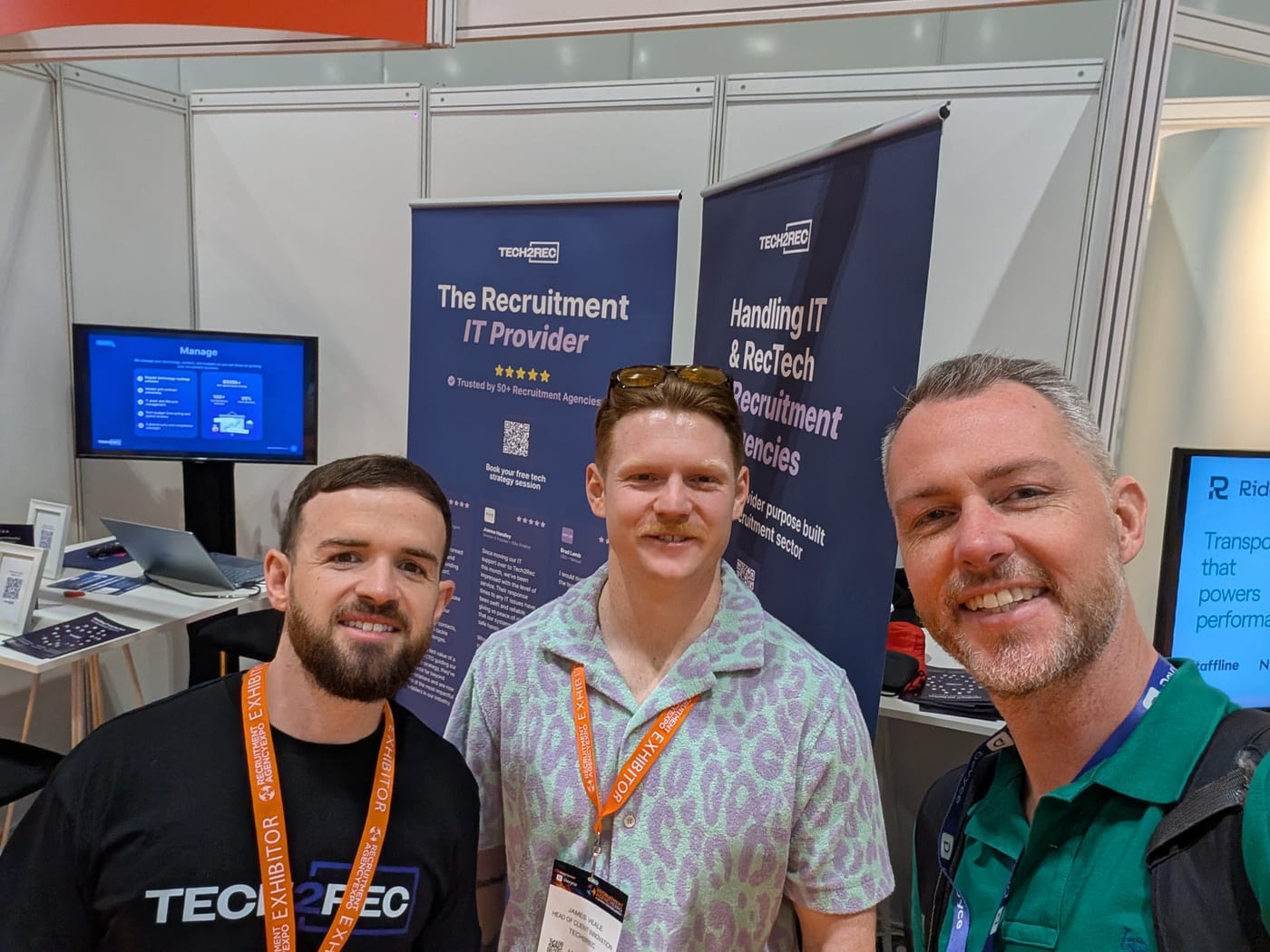 For the last few years, recruitment has been scrambling to understand what's changing.
At last week's Recruitment Agency Expo, it felt like that phase has passed.
The conversations have shifted from what might happen next.
Instead, they were about what is already being implemented in response, and how well it's working.
In essence, it felt like people are becoming much more comfortable with the new technological environment we find ourselves in. And we've largely adapted to cope with the higher rate of change we're all feeling.
What's actually changed?
A few patterns were clear:
- Fewer early and mid-career recruitment professionals attending to learn (which is a shame)
- More business owners, leaders and operators
- A heavier presence of technology than services
But the most important shift was this:
People weren't necessarily looking for ideas.
More than previously, they were looking for:
- Evidence
- Benchmarks
- Validation
Even consistently packed talks like those from Greg Savage were noticeably, significantly quieter.
Not because the content is any less brilliant (it still is). But perhaps because the industry has surpassed the stage of deciding it needs to change, and already has a rough idea of what that is starting to look like.
Now, it's clearly focused on execution.

The underlying opportunity: efficiency
One of the most useful talks I attended was from the team at Meet Dwight. Meet Dwight is a 24/7 digital worker designed to automate tedious recruitment administration tasks like credentialing and timesheet validation.
Their focus was clear: what does a near human-less back or middle office look like, and what does that unlock?
The key word throughout was efficiency.
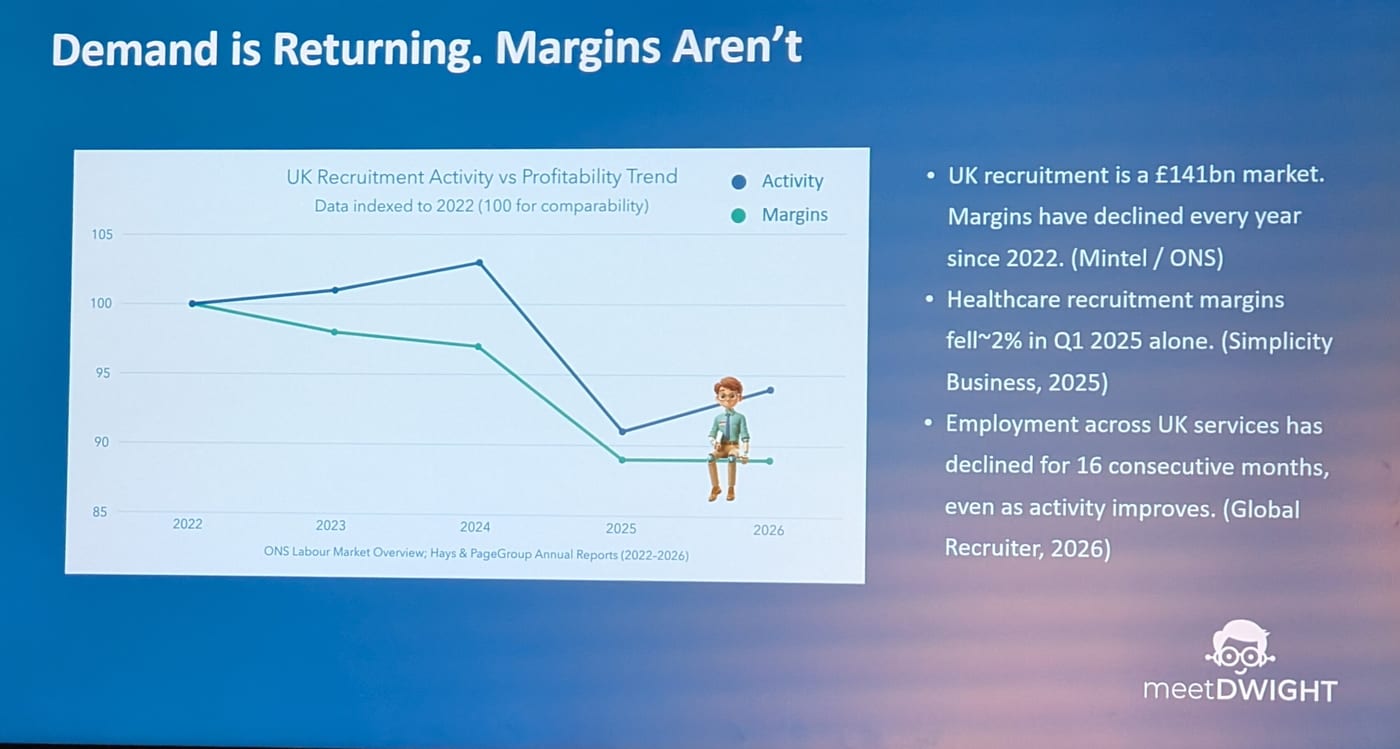
They shared some of their data, showing:
- Recruitment activity is recovering
- But margins are largely flat
That gap is important, because it explains why the industry is now moving so decisively.
It is fantastic that the recruitment industry is experiencing growth again. But growth alone isn't solving the problem. So efficiency becomes the answer.
Where is the industry heading?
When you walk the floor, most of the excitement wasn't in broad, conceptual tools.
It was in tools that clearly and acutely target specific, pre-identified problems or bottlenecks in a process, and offer solutions that deliver:
- Speed
- Volume processing
- Operational leverage
- And importantly, improved candidate experience
That combination is what people are now actively looking to implement.
Not explore. Implement. And that's really exciting.

Where VoiBo and automated voice AI sit in this shift
What's interesting for us is that our focus aligns directly with this move toward efficiency.
Our challenge is that awareness of what's now possible with voice is still relatively limited across the industry. Simply because it is still so new and has developed so fast.
We're part of the process of creating a new category of recruitment tech, and opening up its bandwidth within the sector. It's a hugely rewarding and exciting process, especially with the fantastic results, feedback and commitment we are seeing from clients.
Over the course of the day at the Recruitment Agency Expo, a consistent picture emerged from conversations.
At present, voice AI in recruitment is being explored by only a small number of more advanced agencies. For most, its role, potential and significance within their business remains largely undiscovered.
However, there was a clear consensus that awareness will rise quickly and that interactive voice AI is an inevitable part of the future recruitment tech stack.
Not necessarily for every niche at the very top end.
But across:
- High-volume recruitment
- Mid-level roles
- Structured hiring environments
- In-house processes as well as agency
The reasoning is straightforward:
- Application volumes continue to increase and recruiters can't manage the volume
- Speed of engagement matters more than ever
- Candidate expectations are rising, but candidate experience continues to fall (and now there is no excuse for this)
Front-end processes are where those pressures are felt most. And voice AI is already solving these problems for early adopters.
If you're currently reviewing how your recruitment operation evolves from here, I'd be interested to hear what you're seeing.
Particularly if you're already in the implementation phase. Those conversations are becoming far more valuable than theoretical ones.
And if you have any questions or curiosity about how automated AI phone agents can significantly drive efficiency and improve the candidate experience, I'm only ever a phone call away.
Simon