
The Voice Behind VoiBo · Issue #4
Why high applicant numbers are breaking recruitment (and why better filtering makes it worse)
By Simon Berry · 15 May 2026 · 4 min read
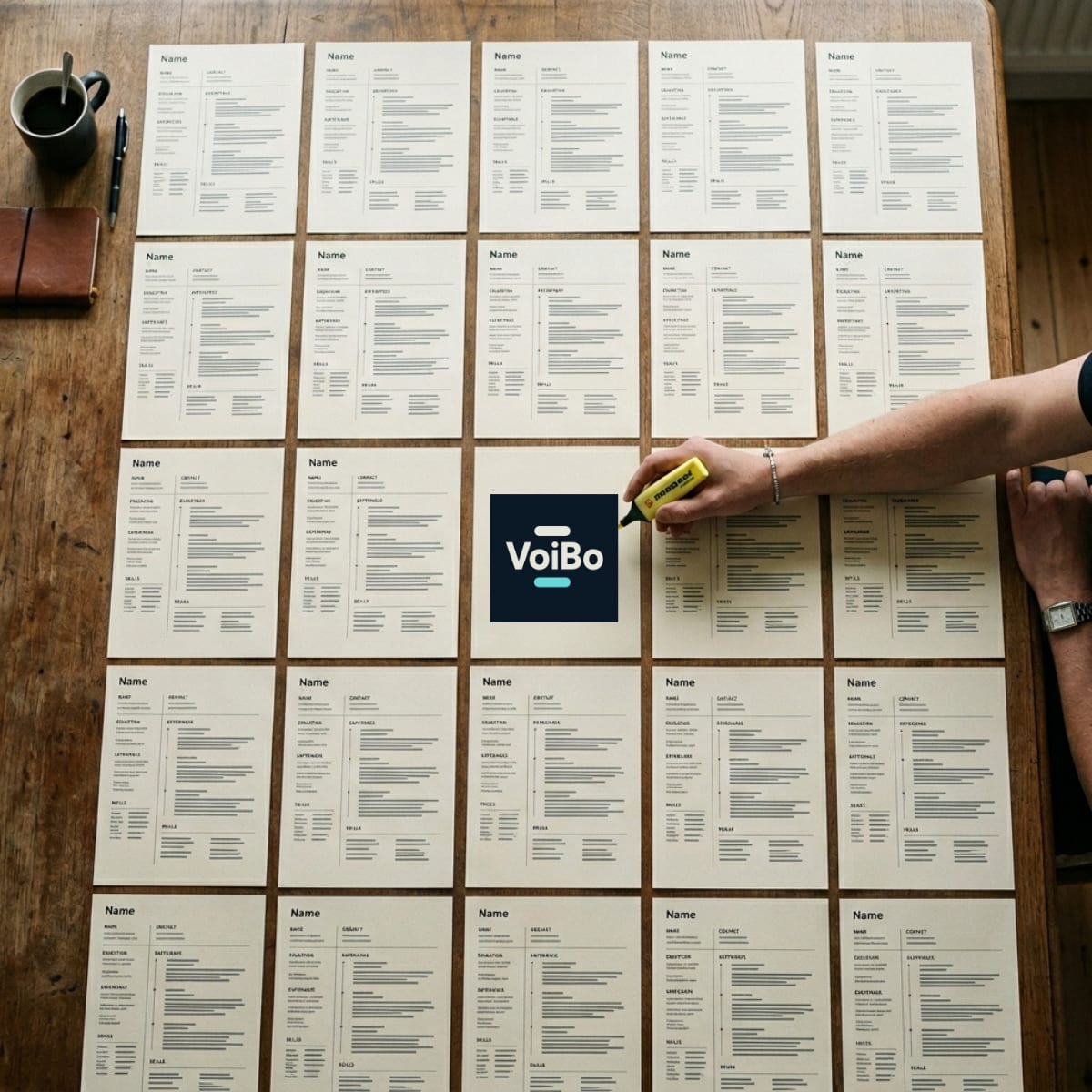 I'm hearing the same thing on nearly every call right now: 300, 400, 500+ applications for a single role. And the conversation almost always defaults to the same place. We need better filtering, smarter ATS rules, tighter screening logic.
Here's my honest take: that's the wrong answer to the wrong problem.
The recruitment industry has spent the last decade getting better at excluding candidates faster. The actual problem is the opposite. We should be focusing on qualifying the right ones in, at a speed and scale the current model simply can't deliver. Until that shift happens, every new tool just helps you reject people more efficiently. It's somewhat at odds with our purpose as recruiters.
At what volume does the process break?
Most recruitment leaders are focused on the wrong number. 500 looks alarming, so it grabs the attention. But what I'm seeing is that the breaking point of the current process isn't 500. It's well below 100. Probably even below 50. Past that point, no human-led front end keeps up. But the failures aren't dramatic. They're almost invisible.
A recent example: a team I've been working with worked through 412 applicants for a single mid-senior role over nine days. By day three, candidates who'd applied on day one were already interviewing elsewhere.
By day nine, four of the strongest candidates from the original pile had already accepted offers.
They didn't lose those candidates because they made bad decisions. They lost them because the model assumes human time can be deployed evenly across the funnel. It can't. Not at this volume.

The new problem nobody's talking about: applications are converging
Here's something I'm watching happen in real time, and I don't think enough people are calling it out: applications are starting to look the same.
Candidates are using AI to polish CVs, rewrite cover letters and tailor responses to job descriptions. The result is that the surface-level signals recruiters have relied on for years (clarity of writing, structure, keyword alignment, apparent attention to detail) are flattening out. The variance is collapsing.
Which means filtering, the very thing the industry is doubling down on, is becoming less effective, not more. If 50 applications all look broadly competent on paper, your ATS rules can't tell you who's actually worth talking to. The differentiation doesn't show up in the written application any more. It only shows up when you talk to people.
That's a fundamental shift. Unfortunately a very time-consuming one. And it's happening faster than most hiring processes are adapting to.
The real bottleneck: engagement, not triage
Here's the reframe I think recruitment leaders need to make.
The industry has been treating high-volume hiring as a triage problem. "How do we sort this many applications into a manageable shortlist?" But the real challenge is an engagement problem. "How do we have a meaningful first interaction with the candidates worth engaging, fast enough that we don't lose them, and consistently enough that nobody falls through the cracks?"
Triage problems get solved with better filters. Engagement problems get solved with better conversations. And conversations don't scale through filtering. They scale through automation that can actually talk to people, not just sort them.
This is where voice AI stops being futuristic and starts being structural. Text-based AI is good at triage, but susceptible to candidates being supported by AI, even at this stage. Voice AI is good at the thing the industry actually needs solving right now: having an early qualifying conversation with hundreds of candidates in parallel, surfacing the ones worth a human conversation, and giving every applicant the dignity of an actual response and the corresponding opportunity to demonstrate their true suitability.
The bottleneck has moved. The tooling needs to move with it.

Where human time should actually go
The current model deploys human time at the front of the process: CV review, initial outreach, first-stage screening. That made sense when volumes were a fraction of what they are now, when applications still carried meaningful signal, and when response time wasn't so directly linked to the outcome. None of these are true any more.
The model I'm seeing working treats human time as the most expensive resource in the process, and deploys it last, not first. Conversational voice AI handles the initial engagement and qualification. Recruiters spend their time on the candidates already surfaced as worth a human conversation, and on the parts of the job that need real judgement: assessing nuanced and qualitative fit, advising clients, closing offers, building relationships.
That's not a reduction in the recruiter's role. It's an important redirection of it. And the teams that make this shift first will have a structural advantage that's going to be hard to close later.
Get in touch
If you're running a desk, team or function where front-end response has become the real bottleneck, I'd genuinely like to hear how you're handling it, and share what I'm seeing work elsewhere.
And if you'd like to see what voice AI looks like applied specifically to this engagement-at-scale problem, that's exactly what we've been building VoiBo to do.
Thanks for reading.
Simon